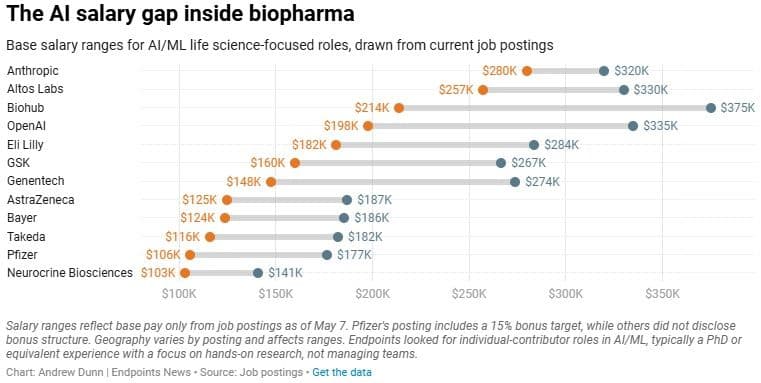
Biotech is getting out-bid for AI talent, and it isn't close. Everyone says the fix is to pay more. It won't be enough.
I lived through this once already, the last time biology tried to hire its way into a new technology.
Ten years ago, in the deep learning era, I watched it from the inside at Exscientia, Insitro, Freenome, Tempus, and many others.
Every AI-bio company was hitting the same wall. There weren't enough people trained in both biology and machine learning. The early teams recruited their friends, ran out of friends, then went hunting at Google, Facebook, Amazon, and Uber for raw ML talent.
Some of the best engineers I ever saw came out of those places. Most of the companies that hired them never made it work.
The biology was foreign to an ML engineer, the problems too abstract, and the two sides spoke different languages. Putting them in the same building did not make them speak the same one.
The companies that got it right did three unglamorous things. They put a dual-trained person in charge of the group. They designed roles an engineer could own end to end without a PhD's worth of biology. And they built a culture where biologists and engineers learned from each other and were treated as equals.
It broke the moment one side won. When biology dominated, the engineers left. When ML dominated, the science got sloppy.
Biotech has always had one advantage the paycheck doesn't capture. The work matters. Steve Jobs once recruited John Sculley by asking whether he wanted to sell sugar water for the rest of his life or come change the world. Curing disease is the same pitch, and it lands even harder.
But mission only covers part of the gap. The pay still has to get close, and most of biotech is nowhere near it. The rest is whether the job lets the engineer feel that impact every day. That feeling is what makes up the difference, and a role designed without it turns biotech back into the low bidder.
Pay sets the floor. Job design sets the ceiling.
81.7K views · 427 engagements
View on LinkedIn