LinkedIn·
More Molecules Isn't the Constraint Anymore. Picking Better Is.
Jeffrey Low, MDView on LinkedIn
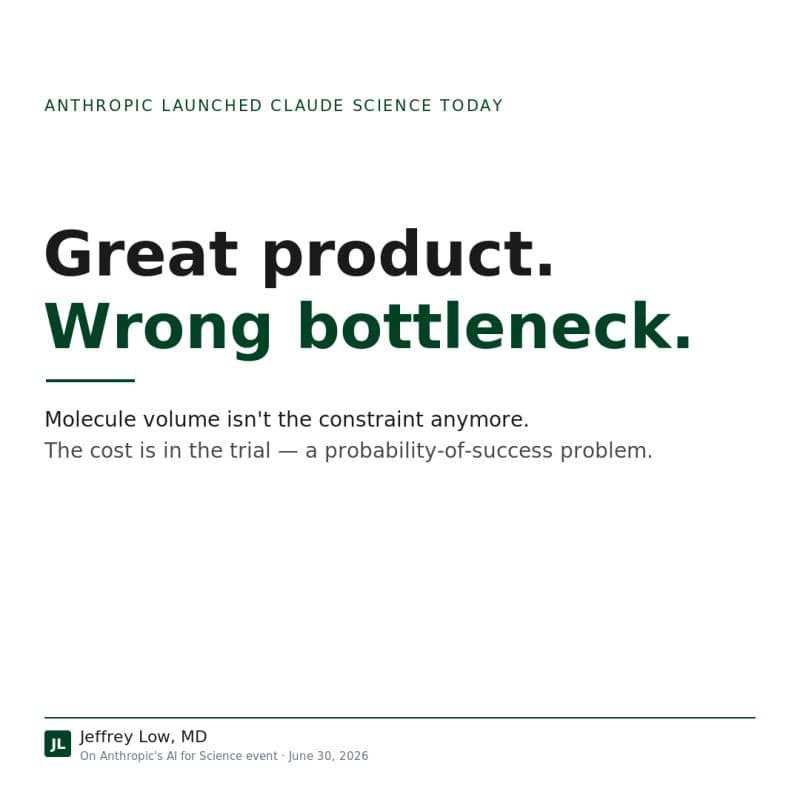
I spent the morning watching Anthropic launch Claude Science. Great product, but it throws AI at a bottleneck drug R&D doesn't have.
The pitch was efficiency: cycle time, analysis toil, faster from experiment to answer. That helps. But molecule volume used to be the bottleneck, and it isn't anymore. Aviv Regev said Genentech's research entries more than doubled in two years, with no new biologists. China is scaling molecule and asset generation at industrial pace right now. New molecules are cheap. The cost lives in the trials.
And that cost is governed by probability of success. POS isn't one thing.
On stage, Novartis CEO Vas Narasimhan split it into four parts. Safety, where he hopes AI helps. The molecule itself, where he's most bullish. Patient selection and the right indication, near-term and promising. And whether it's a good target - the hard one, the part you don't truly learn for ten years.
That last part - is it a good target - is where a lot of AI drug discovery is pointed, and the payoff there is the biggest. It's also the slowest to prove. You don't really know for ten years, which makes it the hardest thing to underwrite on a fund's clock.
I'm not betting against it. The nearer wins are just the other two: better-designed molecules and sharper patient selection. Both move success rates on a timeline you can actually hold.
More molecules isn't the constraint anymore. Picking better is. The molecule and the patient are where you can pick better sooner. The target is the taller mountain - worth the climb, just a longer one.
27.9K views · 321 engagements
View on LinkedIn