LinkedIn·
Would Anthropic Be a Better Buyer for Bristol Myers Squibb Than AstraZeneca?
Jeffrey Low, MDView on LinkedIn
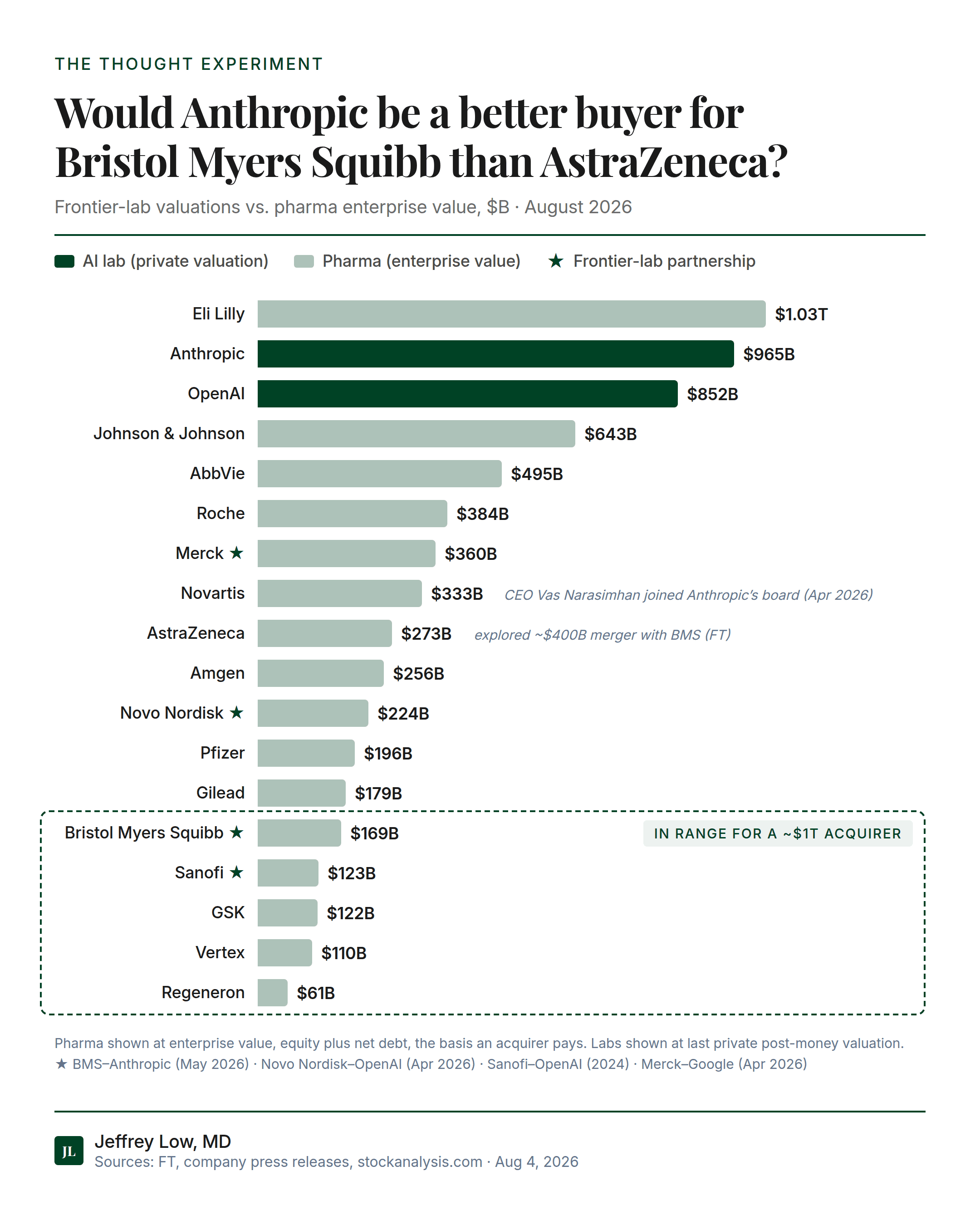
Would Anthropic be a better buyer for Bristol Myers Squibb than AstraZeneca?
The strategic case is debatable. The financial one no longer is.
This week the FT reported that AZ and BMS explored a ~$400B megamerger, the largest deal pharma has ever contemplated. Investors sold AZ off. Analysts said they were "perplexed."
Anthropic's last round priced it at $965B. Only Eli Lilly ($1.03T) is worth more among drug companies. Anthropic already sits ahead of J&J, Roche, Merck, and every other pharma name, and OpenAI at $852B is right behind. Bristol Myers Squibb, the company AstraZeneca just circled, carries an enterprise value of $169B. Anthropic could absorb it and still have three-quarters of a trillion left. AZ and BMS together come to about $440B on the same basis, still under half of Anthropic.
Take the thought experiment seriously. No board spends half its value on one deal. Cap the check near 15%, roughly $145B with a control premium included. Regeneron ($61B) fits easily. So do Vertex ($110B), GSK ($122B), and Sanofi ($123B), if you believe London or Paris would allow it. BMS at $169B is a stretch, not a fantasy.
Strategy is the harder question, and Anthropic has spent the past year answering it. It launched Claude for Life Sciences in October. In April it acquired Coefficient Bio, an ex-Genentech team building drug R&D tools, and seated Novartis CEO Vas Narasimhan on its board. In July it shipped Claude Science, a research workbench aimed at drug discovery. Anthropic says it wants to work on everything from early-stage discovery through translation.
BMS is already an Anthropic partner. In May it deployed Claude across 30,000 employees as its "shared intelligence platform." The merger got the headlines. The Claude deal may shape the company more.
Now compare the two buyers. The cliff in this deal belongs to BMS: Eliquis ($14.4B) and Opdivo ($10B), roughly half its revenue, lose exclusivity in 2028, and Leerink projects the company shrinking to $39B by 2030. AZ expects to grow to $80B by 2030 without M&A. That mismatch is what perplexed the street. The merger buys AZ scale and cost synergies it doesn't need. Jefferies put it plainly: "if there is one company that doesn't need financial engineering, it's AZ."
A pharma acquirer buys revenue, so BMS's cliff is a problem. Anthropic would be buying the discovery engine: the trial infrastructure, the regulatory muscle, decades of proprietary data. The cliff has already marked down the price, and it marks down the part an AI lab doesn't need.
So far, the labs have chosen partnership over acquisition: Novo Nordisk–OpenAI, Sanofi–OpenAI, Merck–Google, BMS–Anthropic.
One of them may turn out to have been diligence.
29.1K views · 164 engagements
View on LinkedIn